Language Spare Parts Google Views

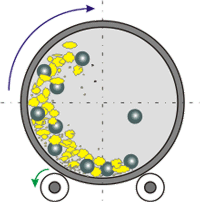
In the world of mineral processing, the grinding of ore bodies takes place using various types of equipment, including ball mills. Traditionally, these mills operate with steel balls that are exceptionally effective at reducing the size of the material being processed. In this article, we will delve into the importance of steel balls for ball mills and how they contribute to grinding efficiency and longevity.
Grinding efficiency is a critical factor in achieving optimal mineral processing results. The use of steel balls in a ball mill is one of the most common and efficient methods to reduce the particle size of hard materials such as minerals, ores, and rocks. These balls are essential for the crushing and grinding process, where they impart high impact and attrition forces to the material, leading to the desired size reduction.
One of the key advantages of using steel balls in a ball mill is their hardness. Steel balls are made from high-quality steel alloys, which exhibit excellent wear resistance and toughness. This enables the balls to withstand the rigorous grinding process without deforming or breaking, ensuring a consistent and efficient operation of the mill. Moreover, the hardness of steel balls ensures that they retain their shape and size over an extended period, resulting in minimal downtime for ball mill maintenance and replacement.
The shape of the steel balls is another critical aspect that contributes to grinding efficiency. Generally, steel balls used in ball mills are spherical in shape, allowing them to roll and tumble freely inside the mill. This movement helps to generate a shearing and grinding action on the material, further enhancing the size reduction process. The spherical shape also ensures even distribution of impact forces across the mill, preventing localized wear and improving overall grinding performance.
In addition to grinding efficiency, the longevity of steel balls in a ball mill is of utmost importance. The wear resistance of steel balls ensures that they can withstand the constant pounding and abrasive forces inside the mill, thereby minimizing ball degradation. Additionally, steel balls are often treated with heat or stone processes, such as quenching and tempering, to further enhance their wear resistance and longevity. These treatments provide the balls with a hardened outer layer, known as a case, which protects the softer core from wear and deformation.
To further optimize the performance of steel balls in a ball mill, it is crucial to select the appropriate size and composition for the specific grinding application. Ball mills operate under varying conditions, such as different ore types, feed sizes, and grinding circuit configurations. Hence, it is important to consult with grinding experts or steel ball manufacturers to determine the most suitable ball size, material composition, and hardness for a particular mill and its operating conditions.
Overall, steel balls play a vital role in ball mill grinding operations, offering enhanced grinding efficiency and prolonged performance life. Their hardness, shape, and wear resistance contribute to optimal size reduction and minimal downtime in mineral processing plants. By selecting the appropriate steel balls for a specific ball mill application, operators can achieve optimal grinding results, maximize throughput, and reduce costs.



