Language Spare Parts Google Views

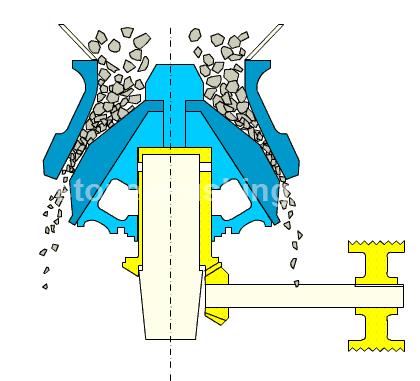
A cone crusher is a popular type of crushing equipment used in industries like mining, construction, and road building. Its working principle is based on the principle of compression. As the name suggests, this machine functions by compressing materials between a stationary cone and a moving cone.
The stationary cone is an outer casing fixed to the frame of the crusher. It houses the crushing chamber where the materials are fed into. The moving cone, on the other hand, is a conical mantle that gyrates within the crushing chamber. It is powered by an eccentric sleeve that rotates around the main shaft.
When the materials are fed into the crushing chamber through the top of the machine, they are crushed between the surfaces of the moving and stationary cones. The space between the two cones decreases as the moving cone gyrates, which exerts a compressive force on the materials. The crushed materials then exit through the bottom of the machine.
The key advantage of using a cone crusher over other types of crushing equipment is its ability to produce uniform-sized particles. This is achieved because the crushing action is continuous and the materials are crushed repeatedly between the two cones until they are broken down to the desired size.
However, the efficiency of a cone crusher is also influenced by several factors, such as the feed size, the speed of the eccentric sleeve, the shape of the crushing chamber, and the hardness of the materials being crushed. Therefore, proper maintenance and careful selection of the right crushing parameters are essential for optimizing the performance of a cone crusher.
Thus, a cone crusher is a powerful and effective crushing machine with a simple operating principle. It is widely used in various industries for its ability to produce consistent and uniform-sized particles. However, it requires proper maintenance and careful selection of the right operating parameters to ensure optimal performance.



