Language Spare Parts Google Views

Jaw crushers have been widely used in the mining industry for decades now, providing numerous benefits to operators seeking efficient and reliable crushing solutions. With their capability to produce precisely sized end-products, jaw crushers play a crucial role in the primary crushing of materials. In this article, we will delve into the mechanics and operation principles of jaw crushers to understand how they efficiently process and deliver various aggregate materials.
A jaw crusher is a compression-type crushing machine that consists of a fixed jaw and a moving jaw. The fixed jaw stays in place while the movable jaw pushes against the fixed jaw, thereby crushing the material to the desired size. The material exits the crusher through the bottom of the jaws, which determines the size of the particles produced.
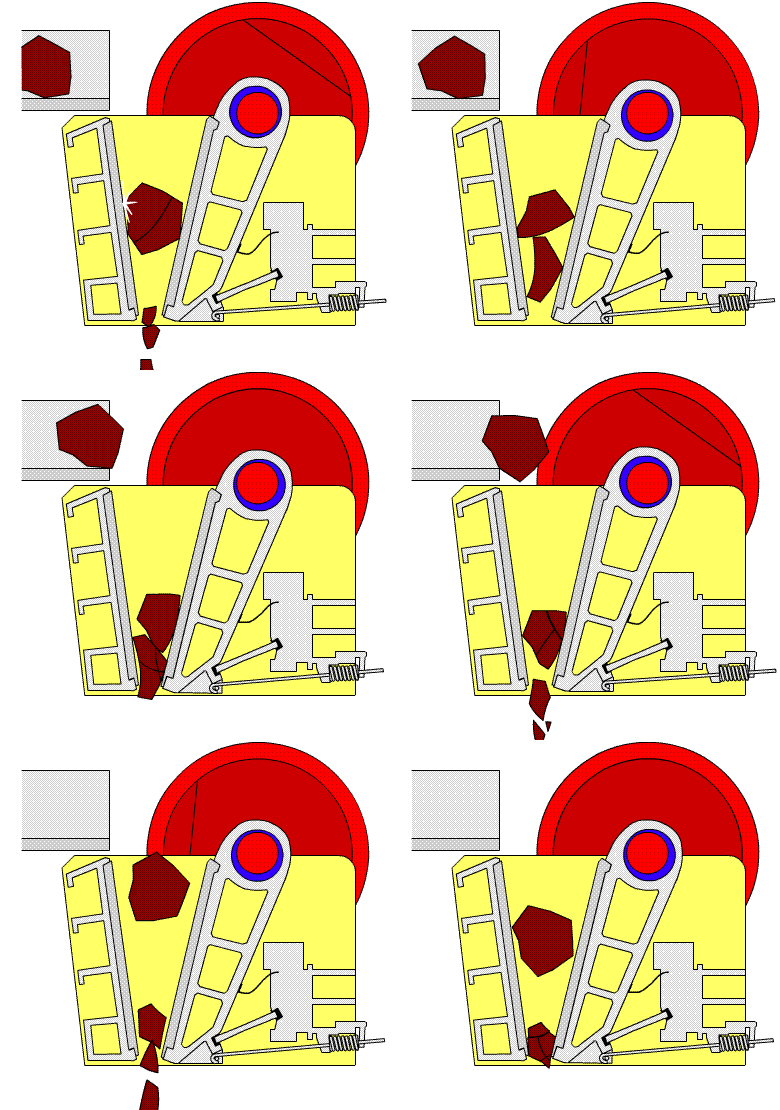
1. Crushing Process:
The process of crushing in a jaw crusher is characterized by its high compressive force. Jaw crushers use mechanical pressure to break the material by applying compressive forces to it. The fixed jaw exerts force on the rock while the movable jaw exerts force against the fixed jaw, crushing the material in between.
2. Working Mechanism:
The working mechanism of a jaw crusher involves the use of a lever and an eccentric shaft. The movable jaw moves back and forth, exerting force on the material, while the eccentric shaft creates the required motion. When the distance between the jaws decreases, the size of the crushed material reduces.
3. Adjusting the Jaw Gap:
Operators can adjust the jaw gap to control the size of the end-product. This can be done by changing the spacing between the jaws or by adjusting the eccentric shaft. By controlling the jaw gap, operators can optimize the crush size to meet specific requirements efficiently.
1. High Efficiency and Productivity:
Jaw crushers are known for their high efficiency and productivity due to their largest possible feed size and high reduction ratio. The larger the feed size, the higher the crushing capacity and efficiency, resulting in improved overall production rates.
2. Versatile Applications:
Jaw crushers are suitable for processing various materials, including hard and abrasive ones such as granite, basalt, and ores. Their versatility allows them to be used in a wide range of applications, from mining to construction, demolition, and recycling.
3. Ease of Maintenance:
Maintenance is crucial for the longevity and optimal performance of jaw crushers. However, their design allows for simple maintenance procedures. Regular inspections, lubrication, and parts replacement ensure smooth operation and extend the lifespan of the equipment.
Understanding the theory behind the operation of jaw crushers provides a foundation for efficient and reliable crushing processes. By utilizing the principles of compression and leveraging the mechanical forces exerted by these machines, operators can produce high-quality end-products in various applications.
From their ability to handle different materials to their adjustable jaw gap and easy maintenance requirements, jaw crushers continue to be an essential tool in the mining and construction industries. Implementing best practices in jaw crusher operation, coupled with regular maintenance, can significantly enhance the efficiency, productivity, and longevity of this valuable crushing equipment.
Overall, the theory behind jaw crusher operation demonstrates the tremendous potential applications of this versatile crushing machine. As innovations continue to emerge, jaw crushers play a vital role in the future of mining and construction industries, offering unparalleled performance, efficiency, and reliability.



