Language Spare Parts Google Views

In the mining industry, the jaw crusher is widely used as a primary crusher machine due to its efficiency and versatility. It is designed to crush and process various materials, making it suitable for different applications in the construction and mining industries. But what exactly is a jaw crusher and how does it work? In this article, we will explore the principle and applications of the jaw crusher.
The jaw crusher works on the principle of squeezing. It consists of two jaws, one fixed and one movable, which are arranged in a V-shaped alignment. The movable jaw plate oscillates back and forth against the fixed jaw plate, crushing material in a crushing chamber. The size of the material that is fed into the chamber is reduced as it moves down through the crushing zone.
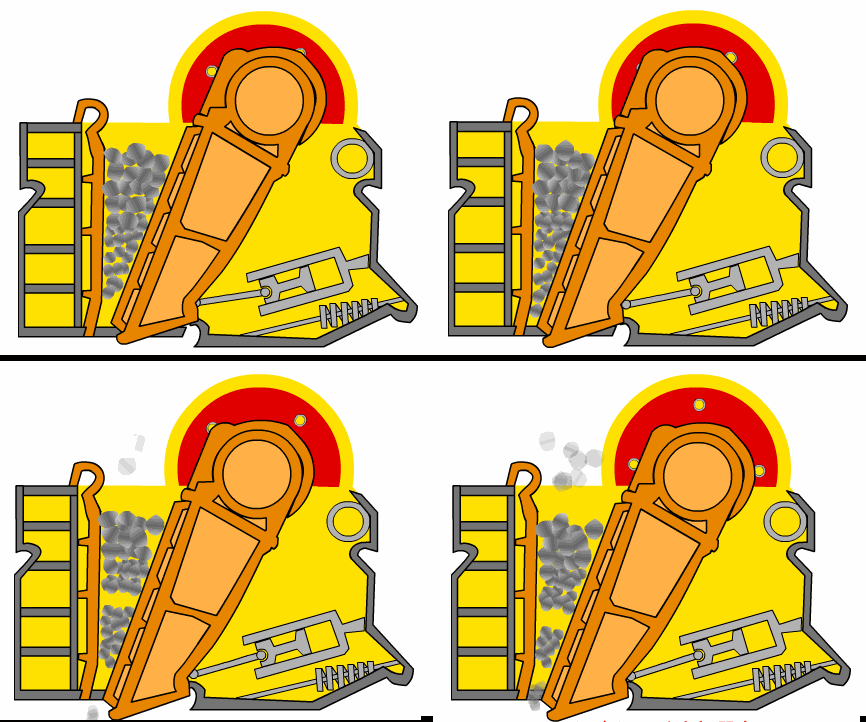
One of the main advantages of using a jaw crusher is its ability to produce a uniform product size. This is achieved through the adjustable discharge opening, which allows the operator to control the size of the final product. The smaller the discharge opening, the finer the crushed product will be. This makes the jaw crusher ideal for producing high-quality end products for applications such as road construction, concrete production, and mineral processing.
Another key feature of the jaw crusher is its high reduction ratio. The reduction ratio is the ratio of the size of the feed material to the size of the product. In jaw crushers, the reduction ratio is generally between 6:1 and 8:1. This means that a primary crusher can produce a product with a maximum size of around 8 inches, while a secondary crusher can reduce it further to a size of about 2 inches.
The versatility of the jaw crusher makes it suitable for a wide range of applications. It can handle a variety of materials, including concrete, gravel, rock, basalt, and other types of stones and ores. This makes it ideal for primary crushing operations in quarries and mines, as well as recycling applications.
In addition, the jaw crusher is often used in combination with other types of crushers, such as impact crushers, cone crushers, and gyratory crushers. This allows for more efficient primary crushing, as the material can be processed in multiple stages, resulting in a finer end product.
Furthermore, the jaw crusher is not only used in the mining industry but also in the construction industry. It can be used to crush construction waste, demolish buildings, and recycle materials, reducing the environmental impact of construction activities.
As a result, the jaw crusher is a versatile and efficient machine that is used in a variety of applications. Its principle of squeezing, adjustable discharge opening, and high reduction ratio make it ideal for producing uniform end products in various industries. Whether it's crushing rocks in a quarry or reducing construction waste, the jaw crusher is a reliable and cost-effective solution. So, if you're in the market for a primary crusher, consider the jaw crusher and its many advantages.



