Language Spare Parts Google Views

When it comes to tackling large boulders in the quarrying industry, there is one machine that stands out from the rest – the jaw crusher. This robust and highly efficient crushing equipment has been around for decades and has gradually evolved to become a game-changer in the industry.
Boulders, which are large rocks typically measuring more than 256 mm in diameter, pose a significant challenge for quarry operators. These massive rocks need to be broken down into smaller pieces to be easily transported and processed for various construction purposes. This is where the jaw crusher comes into play.
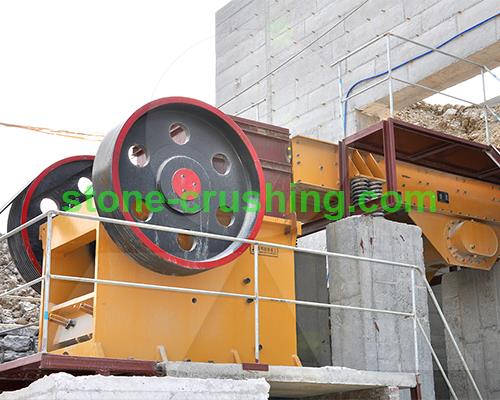
The jaw crusher is a versatile and powerful machine that is designed to handle hard and abrasive materials, such as large boulders. It consists of two jaw plates, one fixed and one movable, which form a V-shaped chamber. As the boulders enter the chamber, they are crushed between the two jaw plates, reducing them in size.
One of the main advantages of using a jaw crusher for large boulders is its ability to achieve a high reduction ratio. A reduction ratio is the ratio of the size of the feed material to the size of the crushed product. In the case of jaw crushers, this ratio can be as high as 1:8, meaning that boulders can be crushed to a much smaller size, making them more manageable for further processing.
Furthermore, jaw crushers offer exceptional throughput capacities, allowing quarry operators to process large volumes of boulders efficiently. This is crucial for meeting the demands of construction projects that require a steady supply of crushed materials.
Another significant advantage of using a jaw crusher for large boulders is its durability and low maintenance requirements. These machines are built to withstand heavy-duty applications and are equipped with robust components that can handle the extreme forces involved in crushing boulders. Additionally, they require minimal maintenance, reducing downtime and increasing productivity.
In recent years, manufacturers have introduced several innovations to enhance the performance of jaw crushers and make them more suitable for handling large boulders. One notable advancement is the introduction of hydraulic systems, which allows for easy adjustment of the jaw crusher's closed side setting (CSS). The CSS refers to the smallest distance between the two jaw plates, determining the size of the crushed product. With hydraulic systems, operators can quickly and accurately adjust the CSS, optimizing the performance of the machine for different-sized boulders.
To summarize, the jaw crusher has proven to be a game-changer in the quarrying industry when it comes to handling large boulders. Its ability to achieve a high reduction ratio, coupled with its exceptional throughput capacity and durability, makes it an essential machine for quarry operations. With continuous advancements and innovations, the jaw crusher continues to evolve, providing quarry operators with an efficient and reliable solution for processing large boulders.
In short, the jaw crusher is a crucial machine in the quarrying industry for breaking down large boulders. Its versatility, high reduction ratio, and durability make it a valuable asset for quarry operators. With ongoing advancements, this powerhouse machine will undoubtedly continue to revolutionize the industry, enabling efficient and sustainable quarrying practices.



